cat5e Vs cat6 Ethernet Cable for Poe Cameras Explained
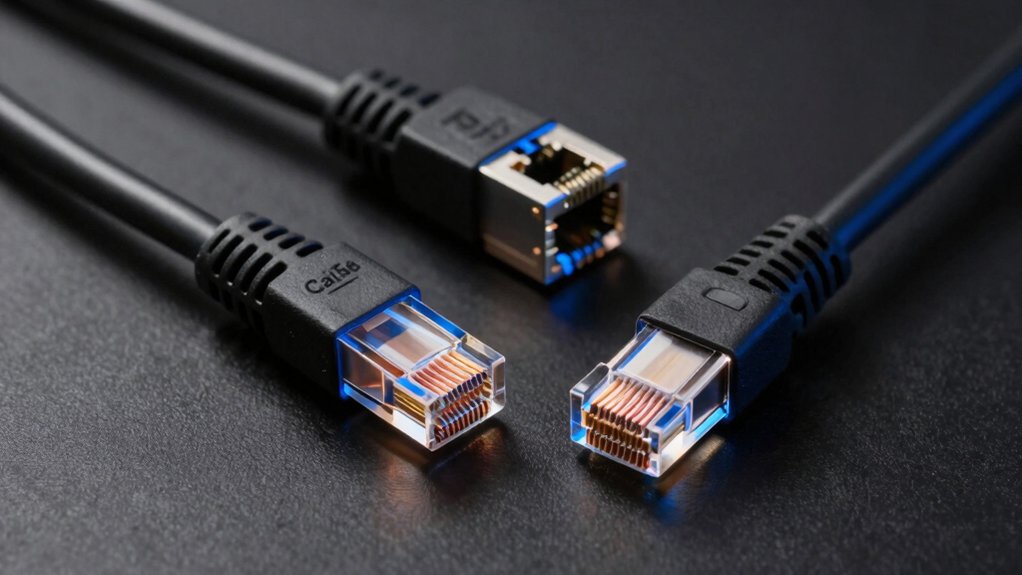
Pick Cat5e for cost‑effective 1 Gbps PoE runs up to 100 m. It handles typical cameras and PoE/PoE+ with proper terminations and is flexible for long, budget installs.
Choose Cat6 when you need better crosstalk control, more PoE margin in dense bundles, improved noise immunity, or headroom for future 10 Gbps on shorter runs (~55 m). Pay attention to shielding, pure copper, and outdoor ratings: more details follow if you want them.
cat5e Vs cat6 Ethernet Cable for Poe Cameras Explained: Pick Cat5e for cost‑effective 1 Gbps PoE runs up to 100 m. It handles typical cameras and PoE/PoE+ with proper terminations and is flexible for long, budget installs. Choose Cat6 when you need better crosstalk control, more PoE margin in dense bundles, improved noise immunity, or headroom for future 10 Gbps on shorter runs (~55 m).
Quick Answer: Best Cable for PoE Cameras
Which cable should you pick for PoE cameras? You’ll usually choose Cat5e for standard runs: it supports 1 Gbps to 100 m and is cost-effective and flexible. If you expect higher interference or want headroom, pick Cat6 for its reduced crosstalk and better interference mitigation; it supports 10 Gbps to 55 m and 1 Gbps to 100 m.
Use shielded Cat5e as a minimum in electrically noisy environments; use shielded Cat6 where noise is significant. Cat6A gives 10 Gbps beyond 55 m, but it is typically overkill for camera deployments.
Factor installation complexity: Cat6 is thicker and stiffer, raising labor and bend-radius concerns. Also confirm termination standards on both ends: consistent connectors, proper pair untwist, and correct grounding for shielded cable are essential to preserve performance and PoE reliability.
Match cable choice to run length, environment, and budget rather than assuming the highest grade is necessary.
How PoE Cameras Use Cable (Speed, Power, Distance)
How do PoE cameras actually use the cable for both data and power? You transmit DC power and Ethernet frames simultaneously over twisted pairs per IEEE 802.3af/at/bt. The cable carries up to 1 Gbps on Cat5e and typically 1 Gbps (with better headroom) on Cat6. Cat6 also supports 10 Gbps to ~55 m.
Power delivery follows the PoE class: 802.3af (~15.4 W), 802.3at (~30 W), and 802.3bt (higher). For a short run and budget focused installs, Cat5e will usually handle standard IP cameras delivering data plus PoE at 15–30 W with acceptable voltage drop. When camera power requirements increase or runs approach 100 m, Cat6’s lower resistance and improved high-frequency performance reduce loss and preserve voltage margin.
Decide by matching camera wattage, run length, and desired data rate. Short, low-power links can use Cat5e; higher power, longer, or future 10 Gbps needs favor Cat6.
Cat5e for PoE Cameras: Performance and Use Cases
Wondering whether Cat5e will handle your PoE camera run? You can rely on Cat5e for most PoE camera deployments; it supports 1 Gbps up to 100 m, matching typical camera data rates and keeping latency low. For budget-conscious projects, Cat5e’s thinner conductors and simpler cable termination speed installs and reduce labor costs.
You’ll get adequate power delivery for standard PoE and PoE+ cameras on typical runs, provided you follow distance limits and use quality connectors. For environments with electrical noise, choose shielded Cat5e to mitigate interference; otherwise, unshielded Cat5e performs well.
Cat5e is cost-effective for short-to-moderate runs and common in retrofit or large-scale, price-sensitive systems. If you need substantial future headroom or higher PoE margins, Cat6-family choices are available. However, for current standard-resolution cameras, Cat5e delivers reliable throughput, predictable power, and straightforward termination without unnecessary expense.
Cat6 for PoE Cameras: Bandwidth, Crosstalk, Headroom
If Cat5e handles most standard PoE camera jobs, Cat6 gives you measurable headroom where bandwidth, crosstalk control, and power integrity matter. You get up to 250 MHz signaling and tighter pair twists; thus, data paths are cleaner and PoE power delivery encounters less electrical noise. That higher bandwidth supports 10 Gbps up to about 55 meters, which is well beyond typical camera runs and provides margin for future upgrades.
Cat6’s internal spline shielding—an internal plastic separator—maintains pair geometry and reduces alien crosstalk between adjacent cables in conduit or bundled runs. Lower near-end and far-end crosstalk and reduced external interference improve link margin; therefore, power-hungry cameras sustain voltage and data integrity over longer or electrically noisy routes.
In practice, you’ll notice the benefit most on shorter high-power runs, dense bundles, or installations near noisy equipment. For basic, low-power cameras, Cat5e still often suffices.
When Cat5e and Cat6 Behave the Same (Distance Limits)
When do Cat5e and Cat6 actually differ for PoE camera runs? Up to 100 meters (328 ft), both deliver 1 Gbps, so for typical PoE camera deployments you’ll see no practical difference under that distance.
Cat6 can support 10 Gbps, but only up to roughly 55 meters; beyond ~50 meters (165 ft), that advantage disappears and throughput aligns with Cat5e. For runs longer than 165 ft, the 10 Gbps claim becomes an irrelevant tangent or marketing spin. In real installations, both cables behave the same in terms of bandwidth.
PoE power delivery and reliability over these distances depend on correct terminations, quality components, and compliant field work. With those controls in place, Cat5e and Cat6 will perform equivalently for camera throughput on typical runs. Choose Cat6 only if you need guaranteed 10 Gbps within shorter links or prefer its slightly tighter specs for future-proofing.
Installation Factors: Shielding, Pure Copper, and Environment
How should you factor shielding, conductor material, and environment into cable selection? You’ll choose UTP for low noise, short runs and FTP/SFTP or fully shielded Cat5e/Cat6 where EMI, nearby power lines, or dense cable bundles create interference. These shielding considerations reduce crosstalk but only work with shielded connectors and a proper ground.
Inspect conductor specs for copper purity; prefer 24 AWG pure copper to minimize attenuation and impedance. Avoid copper-clad aluminum (CCA) because it raises loss, heats under PoE, and reduces long-term reliability. For outdoor, conduit, or direct-burial runs, use outdoor-rated or direct-burial cables with UV jackets and gel or sealed terminations to prevent moisture ingress and preserve electrical characteristics.
Install shield continuity carefully: bond shields at a single point or per local code to prevent ground loops. In short, match shielding to noise environment, insist on pure copper conductors for PoE reliability, and select environmental ratings appropriate to exposure.
Cost vs Future‑Proofing: Budget Guidance and Default Choice
Want to balance upfront cost against long-term capability? You’ll perform a clear cost comparison: Cat6 costs more upfront than Cat5e but delivers greater headroom for bandwidth and PoE loads. For typical camera deployments, Cat5e is the cost-effective default; it delivers 1 Gbps to 100 m and meets most current needs.
Choose Cat6 when your future planning anticipates higher-resolution cameras, additional PoE devices, or network upgrades within the cable’s service life. Cat6’s advantage is strongest on shorter runs (up to ~55 m) where it can support 10 Gbps; this reduces the need to re-cable later.
When budgeting, quantify expected upgrade timelines and run lengths. Pay the premium for Cat6 only when projected demands exceed Cat5e’s capabilities before your planned refresh. If uncertainty remains and budgets are tight, default to Cat5e now; document pathways and conduit for easier future upgrades. Reserve Cat6 for runs where future use or short length maximizes its benefit.
Quick Decision Guide: Pick by Camera, Run Length, and Goals
Which cable should you pick depends on the camera type, run length, and upgrade goals: Use Cat5e for standard 1 Gbps PoE cameras up to 100 m and conservative budgets. Choose Cat6 where you need extra interference rejection, PoE margin, or headroom for higher-resolution cameras and short-run 10 Gbps (up to ~55 m).
If you deploy typical 1 Gbps PoE cameras on runs up to 100 m in a low-noise installation environment, Cat5e is cost-effective and meets specs. For installations with high electromagnetic noise, dense cable bundles, or plans to move to higher-resolution cameras or higher PoE budgets, Cat6 gives improved NEXT, better PoE margin, and simpler upgrades.
When runs exceed ~50 m at high bandwidth, performance converges; Cat5e can be chosen for long, budget-driven runs. Use future proofing considerations to decide whether marginal upgrade cost buys operational headroom. Match cable choice to camera requirements, measured run length, and the installation environment to avoid overspending or under-provisioning.
Frequently Asked Questions
Can Poe Cameras Run Over Mixed Cat5e and Cat6 Cable Runs?
Yes, you can run PoE cameras over mixed Cat5e and Cat6 runs, but you’ll need to ensure POE compatibility and preserve cable integrity. Use the lowest-spec segment (Cat5e) for power and data budgeting. Keep runs within length limits, and avoid poor joints or untwisted pairs.
Test each run for continuity, resistance, and PoE load. If you see voltage drop, replace segments or upgrade to full Cat6 to maintain reliable operation.
Does Cable Color or Jacket Type Affect Poe Performance?
No, cable color and jacket type don’t change PoE electrical performance as long as conductors and pairs meet spec. You should care about cable aesthetics and jacket materials for installation: colored jackets help identify runs and match décor.
Jacket materials (PVC, LSZH, plenum) affect fire safety, flexibility, and UV resistance. Choose the proper jacket for the environment. Keep conductor gauge, pair integrity, and terminations correct to ensure reliable PoE.
How Does Ambient Temperature Affect Poe Power Delivery Over Cables?
Higher ambient temperature reduces PoE power delivery by increasing cable resistance and thermal derating. This causes greater I^2R losses and potential power budget limits. You’ll see higher voltage drop over cable length, which can impair device operation and signal integrity.
Keep runs shorter; use lower-gauge or better-spec cable; or allow thermal margins in your power budget to maintain reliable power delivery and preserved signal integrity under warm conditions.
Are Connectors and Patch Panels Equally Important as Cable Grade?
Yes, connectors and patch panels matter as much as cable grade. You’ll choose connector grade to match conductor type and minimize resistance; poor connectors raise heat and voltage drop.
Set patch panel priorities for pair integrity, proper termination, and cooling to preserve PoE. Follow wiring standard relevance (T568A/B) consistently to avoid split pairs. Together, high-quality components and correct standards ensure reliable PoE power delivery and network performance.
Can Cable Testers Reliably Verify Poe Capability and Wiring Quality?
Yes, cable testers can reliably verify PoE capability and wiring quality, but you’ll need the right tools. Use a PoE-capable tester to confirm voltage, pair usage, and power budgeting. Additionally, use a wire-mapper/tones tester for continuity, split pairs, and shield integrity.
Tester accuracy varies; therefore, calibrate and choose models that report power class and load. Also, validate insertion loss and return loss with advanced testers for full confidence.
Conclusion
Pick Cat6 for new or long runs, higher-resolution cameras, or tougher EMI environments. Pick Cat5e for short runs, strict budgets, or existing wiring that already meets specs. Both support 802.3af/at/bt PoE to 100 meters if cables are good quality and terminations are proper.
Prioritize solid pure‑copper conductors, correct shielding where needed, and professional installation practices. Choose Cat6 for modest future‑proofing. Use Cat5e only when cost and distance make sense.