Infrared Vs Color Night Vision Explained

You’ll pick color night vision when ambient light or low‑power illumination lets you keep true color for identifying clothing, vehicles, and scene context. It amplifies visible light for forensic detail but needs some light; it can be more costly.
Choose infrared for reliable, covert detection in zero‑light: IR LEDs give high‑contrast grayscale at extended range with less power and lower cost. Keep going and you’ll get practical trade‑offs, lighting rules, and a spec checklist to decide.
Infrared Vs Color Night Vision Explained: You’ll pick color night vision when ambient light or low‑power illumination lets you keep true color for identifying clothing, vehicles, and scene context. It amplifies visible light for forensic detail but needs some light; it can be more costly. Choose infrared for reliable, covert detection in zero‑light : IR LEDs give high‑contrast grayscale at extended range with less power and lower cost.
Quick Decision: IR vs Color Night Vision (TL;DR)
Which do you need: color for ID or IR for pure darkness? You’ll choose based on environment and objective. If identification matters—clothing, vehicle color, situational context—pick color night vision: it amplifies ambient light, relies on sensor sensitivity, and preserves color balance for forensic value.
If conditions include true zero light or you require covert coverage, pick IR: IR LEDs provide invisible illumination, deliver monochrome imaging, and extend effective range without relying on ambient sources.
Assess trade-offs quantitatively: color mode improves identification but needs some light or spot illumination and may increase power draw. IR offers superior power efficiency for extended runtime in autonomous systems and guaranteed visibility in total darkness.
Also factor sensor resolution: higher-resolution cameras (2K/4K) enhance identification in both modes. In short, prioritize color for identification fidelity and situational clarity; prioritize IR for stealth, range, and low-light independence.
How Color Night Vision Works And What It Shows
How does color night vision capture hues when light is scarce? You rely on larger, higher‑gain image sensors and wide‑aperture optics that maximize photon collection. Increased sensor sensitivity lets the system amplify ambient photons so color channels retain usable data. The camera processes amplified RGB signals to preserve color accuracy; however, amplification increases noise that can shift hues under marginal illumination.
When ambient light is insufficient, some units add active illumination: visible spotlights guarantee chromatic capture. You’ll get more reliable identification of clothing, vehicle paint, and scene context at the cost of being more conspicuous. Without added light, the system defaults to grayscale or noisy, desaturated color because sensor sensitivity limits color discrimination.
Operationally, you balance aperture, gain, and illumination to optimize color accuracy versus concealment. For forensic needs where identification matters, color night vision provides higher interpretive detail than monochrome IR; however, you must accept potential trade‑offs in noise and visibility.
How Infrared (Near‑IR) Night Cameras Work
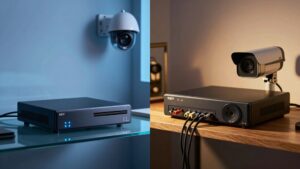
Color systems trade color fidelity for higher sensor gain and occasional visible illumination; infrared (near‑IR) cameras take the opposite approach by illuminating the scene with near‑IR light and capturing reflected photons as a monochrome image. You rely on an array of IR LEDs around the lens that activate when ambient light falls below a threshold, producing controlled illumination invisible to the eye.
The camera retracts an IR cut filter at low light to permit near infrared onto the sensor. During daytime, the filter blocks IR to preserve color accuracy. Because the sensor detects reflected IR rather than visible wavelengths, you get a high-contrast grayscale feed that operates in complete darkness without ambient light.
This monochrome imaging yields discreet, reliable detection and good effective range within LED illumination limits. The trade-off is loss of color cues needed for identification tasks: clothing, vehicle color, and other chromatic details are not available from IR-only captures.
Image Differences: Color Detail, Range, And False Positives
Why does night imaging look so different between systems? You’ll see that color night vision preserves color saturation and scene detail by amplifying ambient light with sensitive sensors, so clothing, vehicle paint, and signage remain identifiable.
Infrared systems, by contrast, produce monochrome images driven by thermal contrast or reflected IR illumination. This highlights heat differentials but sacrifices true color cues.
Range differences follow logically: color systems depend on available light or spot illumination, limiting effective distance. IR extends detection in total darkness but can white-out on close, high-reflectance subjects or lose detail at long ranges.
Regarding false positives, color imaging can increase misidentifications when lights accentuate non-target objects. While IR/thermal reduces color-based errors, it still misreads reflective surfaces or objects with similar emissivity.
Hybrid systems may introduce false color rendering; thus, validate targets against thermal contrast metrics and known illumination conditions to minimize errors.
Lighting And Environment: Which Tech Performs When
Having compared image characteristics and error modes, you now need to match sensor type to lighting and environmental conditions to get reliable results. In complete darkness, you’ll deploy infrared: IR LEDs illuminate scenes invisible to people, producing high-contrast monochrome images independent of ambient light. That makes IR optimal for discreet surveillance and reduces motion-detection false positives tied to color shifts from variable lighting.
Where street or landscape lighting exists, color night vision performs well; it amplifies ambient light to preserve color accuracy and identification detail—useful for recognizing clothing or vehicle colors. In low-but-not-zero-light scenarios, color sensors yield more natural images; in zero-light, they’ll fail without a spotlight. Choose IR when stealth, consistent detection, and operation in blackout conditions matter. Choose color when you need immediate identification and the environment supplies enough light.
Hybrid systems can switch modes to minimize false positives while maximizing color accuracy across varying environments.
Cost And Maintenance: IR vs Color Night Vision
Which option fits your budget and maintenance capabilities? Do a strict cost comparison: infrared systems are generally more economical upfront and over lifecycle because they use simpler sensors and consume less power. Color night vision demands higher-spec image sensors, possible built-in spotlight hardware, and advanced optics; this drives up purchase and replacement costs.
From a maintenance workflow perspective, IR systems are simpler: fewer moving parts, lower power draw, and minimal calibration mean that routine checks focus on lens cleanliness and IR emitter integrity. Color systems require more involved upkeep; this includes periodic calibration of sensors, inspection and replacement of lighting modules, and attention to optics to preserve color fidelity under low light.
Operational costs follow the same pattern: IR’s energy efficiency and simpler components reduce total cost of ownership. Meanwhile, color units incur higher service and parts costs but offer superior identification capability.
Match your choice to required identification performance and available maintenance resources.
Buying Checklist: Specs To Pick The Right Night Camera
Now that you’ve weighed cost and maintenance, narrow your choices by matching performance specs to the intended placement and operational constraints. First, choose sensor type: pick color night vision for entry points where identification of clothing, car color, and faces matters. Pick IR for covert, long-range, or totally dark areas.
Next, prioritize resolution: 2K or 4K improves detail in both modes and is critical for license-plate and facial recognition. Evaluate illumination: confirm required ambient lux for color mode or IR LED range for full-dark coverage. Check field of view and mounting aesthetics so the camera’s angle and profile suit the site without drawing attention.
Review power and connectivity; PoE simplifies installs. Wireless may impact latency. Assess storage, compression, and night-mode switching behavior. Finally, factor privacy concerns: select cameras with secure firmware, configurable masking/zones, and clear data-retention controls to meet legal and ethical obligations.
Frequently Asked Questions
Do IR or Color Night-Vision Cameras Record Audio?
No, most IR illumination or color night-vision cameras don’t record audio by default. You’ll need a model with dedicated audio capture hardware and microphone input.
If audio capture is required, verify microphone specifications, signal-to-noise ratio, and whether the camera supports simultaneous audio-video synchronization and privacy regulations. You’ll also consider bandwidth, storage impact, and whether IR illumination affects microphone performance in low light. Choose units with integrated or external mic options accordingly.
Can IR or Color Systems Identify Faces Reliably at Distance?
You can sometimes achieve face recognition at distance, but reliability falls with resolution, lighting, lens, and algorithm quality. Infrared systems boost contrast in low light; yet they often lose fine detail. Color night systems preserve more texture when illumination exists.
At longer ranges, identification errors rise, increasing false matches. You should consider privacy implications: deploying long-range recognition demands strict data handling, consent, retention limits, and legal compliance to mitigate misuse.
Are There Legal Restrictions on Using IR Illumination Outdoors?
Yes, you’ll face outdoor regulations and privacy concerns when using IR illumination outdoors. Many jurisdictions restrict surveillance intensity, placement, and recording without consent; some ban continuous targeted lighting that invades private spaces.
You’ll need to check local statutes, municipal codes, and data-protection laws. Additionally, consider signage and consent procedures. Conduct technical assessments to limit spill, use low-power or directional IR, and document compliance to mitigate legal and privacy risks.
How Do Weather Conditions Affect IR Sensor Lifespan?
Weather extremes accelerate IR sensor degradation: you’ll see UV sensitivity shifts and thermal wear increase under prolonged sun, high UV, or rapid temperature cycling. Moisture and salinity corrode optics and electronics. Condensation causes micro-cracks and delamination, reducing sensitivity.
Cold slows chemical aging but can induce stress fractures; heat promotes thermal drift and accelerated aging. Proper sealing, UV-stable coatings, and temperature-controlled housings will extend operational lifespan.
Can Smartphones Replicate Dedicated Night-Vision Performance?
No, you can’t fully replicate dedicated night-vision performance with a smartphone. Smartphones face IR limitations: tiny sensors, limited lens aperture, and consumer IR filters reduce sensitivity.
Computational tricks and low-light modes improve apparent detail, but they can’t match true sensor gain, thermal imaging, or long-range IR illumination. For close-range, well-lit scenes, you’ll get usable results; yet for professional surveillance or low-visibility tasks, dedicated night-vision remains superior.
Conclusion
You’ll pick IR when you need reliable, long-range detection in total darkness with minimal false color cues. Choose color night vision when color detail matters for identification at shorter ranges and in scenes with some ambient light.
Balance range, sensitivity (lux), IR wavelength, and sensor size against budget and maintenance. Check true low‑light specs, HDR capability, and trigger accuracy; these determine practical performance more than marketing terms.
Prioritize objective test data.
Related reading: Outdoor Security Cameras with 2K in — a closer look at this topic.