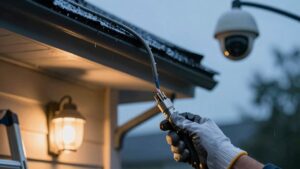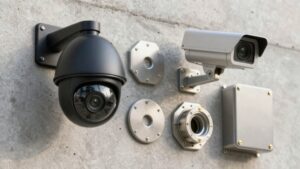
Using Motion Sensors to Trigger Lights for Deterrence
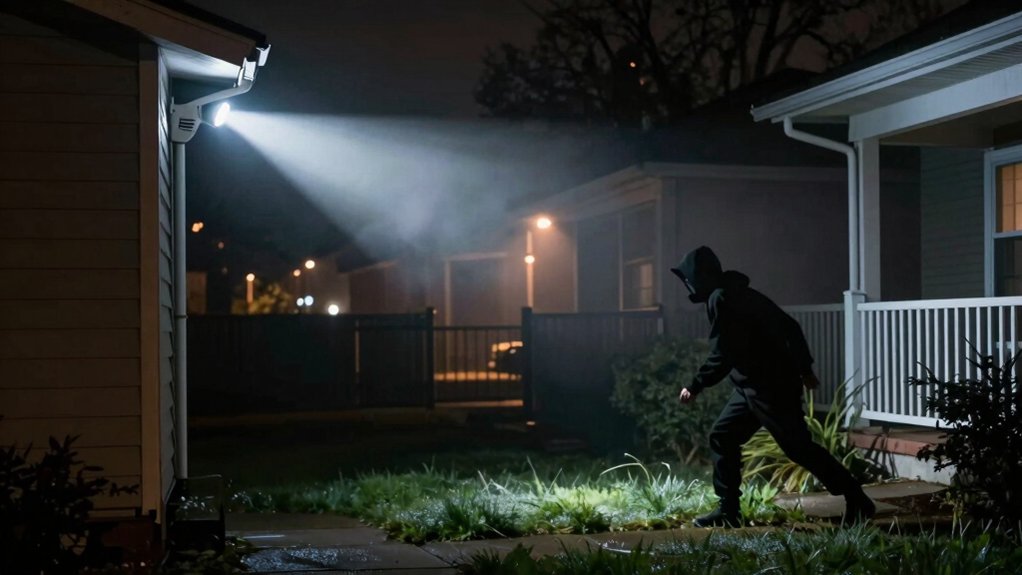
Motion-activated lights are an effective, low-cost deterrent when you use fast-response PIR sensors that illuminate targets within 0.5 to 1.0 seconds; these sensors output enough lumen to break concealment without blinding cameras.
You’ll want adjustable sensitivity, defined detection zones, and dwell timers to limit false triggers from animals or foliage.
Integrate with cameras, alarms, or a smart hub for layered response and event logging. Continue below to see placement, tuning, and installation tradeoffs.
Using Motion Sensors to Trigger Lights for Deterrence: Motion-activated lights are an effective, low-cost deterrent when you use fast-response PIR sensors that illuminate targets within 0.5 to 1.0 seconds; these sensors output enough lumen to break concealment without blinding cameras. You’ll want adjustable sensitivity, defined detection zones , and dwell timers to limit false triggers from animals or foliage.
Quick Answer: Do Motion-Sensor Lights Deter Intruders – And First Steps?
Wondering whether motion-sensor lights actually stop intruders? You can answer decisively: they deter by sudden illumination that triggers a fight-or-flight reflex and exposes suspicious activity. You should position lights to cover entry points and program unpredictable activation patterns rather than constant illumination to maximize perceptual risk.
Implement rapid-response sensors calibrated for range and sensitivity so a well-timed flash disrupts concealment and increases retreat probability or movement toward witnesses. Integrate lighting with cameras and alarms to create layered detection and verification; this raises the expected cost to an intruder.
As you deploy systems, document ethics considerations and privacy concerns: avoid sensors that intrude on neighbors’ private spaces and configure mounting, angles, and timers to limit spillover. Finally, perform a methodical site survey, test activation latency, and log false-trigger rates. Use those metrics to iterate placement and settings for reliable deterrence without unnecessary nuisance activations.
How Motion-Activated Lights Stop Intruders : Fast
How exactly do motion-activated lights stop intruders so quickly? You’ll rely on sudden illumination to disrupt concealment and force immediate behavioral change. A bright, unexpected flash creates a startle effect that raises stress hormones and prompts a rapid fight-or-flight decision; this often produces retreat.
Because lights activate only on detected motion, you reduce predictability compared with constant lighting. This denies criminals patterns they can exploit. Expanded coverage and 360-degree sensing increase the probability the system responds before an approach becomes entry.
You’ll also limit light saturation to avoid blinding cameras or creating hard shadows that adversaries can exploit. Calibrated lumen output preserves visibility for occupants and integrated cameras. Integrating lights with alarms and cameras produces layered cues: visual, auditory, and recorded evidence that compound deterrent value.
Finally, maintain sensor privacy by isolating detection data from public networks. This prevents exposure of activation patterns that could otherwise be analyzed and countered.
How Motion Sensors Detect People and Vehicles
Why do motion sensors reliably tell people and vehicles apart? You rely on passive infrared (PIR) sensors that measure differential heat signatures and movement patterns: humans produce compact, oscillating heat sources with gait frequency; vehicles generate larger, slower-moving thermal profiles. The sensor’s algorithm compares signature shape, amplitude and velocity to reject small animals, avoiding false activations.
You’ll adjust sensitivity and detection range to match target zones—entryways, walkways, driveways—so the system discriminates expected targets without triggering on irrelevant sources.
You can select 360-degree or wide-angle units to increase early detection and deterrent timing. Integration with smart-home platforms lets the sensor trigger lights and simultaneous camera alerts or notifications, giving correlated evidence for verification.
Don’t assume one-size-fits-all performance; tune thresholds and use complementary sensors if classification remains unclear benefits in specific scenes. Maintain methodical testing to confirm the two word ideas of range and sensitivity deliver consistent detection.
Where to Place Sensors and Lights for Reliable Coverage
Where should you mount motion sensors and lights to get reliable coverage? You’ll position sensors at key entry points: doors, driveways, sidewalks. This will maximize early detection and reduce security gaps. Use 360° or wide-angle sensors to expand detection and limit blind spots near corners and landscaping.
Mount lights high enough to avoid small-animal triggers while clearly illuminating approaching people. Place sensors to trigger sequential lighting along pathways and stairs so illumination follows an approach from multiple directions.
Don’t mount sensors behind plants, porches, or vehicles. Obstacles cause missed detections and false activations; this degrades reliability and raises privacy concerns if beams cross into neighbors’ windows.
| Component | Recommended Placement |
|---|---|
| Entry doors | 6–8 ft, angled to cover threshold |
| Driveways | Elevated, centered, wide-angle sweep |
| Pathways/stairs | Sequential sensors along route |
| Corners/landscape | 360° or overlapping coverage |
Calibrate sensitivity and angles during dusk and dawn tests to verify coverage without persistent false alarms.
Top Features to Choose: PIR, Sensitivity, Timers, LEDs, Connectivity
Which features should you prioritize when pairing motion sensors with lights for reliable deterrence? Choose PIR motion sensors first: they detect infrared heat signatures, distinguishing people and vehicles from small animals and cutting false activations outdoors. Specify adjustable sensitivity and defined detection zones so you can match coverage geometry to your yard or campsite. This minimizes nuisance triggers while maintaining necessary range.
Select timers that offer configurable dwell time; shorten for energy savings or extend for continuous pathway illumination depending on function. Use LED fixtures for high lumen output, low wattage, and long lifespan. This makes them ideal for frequent, bright deterrence lighting events. Prioritize connectivity options (Wi‑Fi or smart home integration) to enable remote control, scheduling, and coordination with cameras or alarms for automated responses and event logging.
Combine these features methodically: PIR core, tailored sensitivity and zones, programmable timers, LED efficiency, and reliable connectivity to create a robust, low‑false‑alarm deterrence lighting system.
Set Sensitivity and Timing to Avoid False Triggers (Animals, Foliage, Traffic)
With PIR, sensitivity, timers, LEDs, and connectivity set, you’ll next tune sensor range and timing to minimize false activations from animals, foliage, and passing traffic. You’ll match sensitivity to the environment, favoring lower gain where small animals or fluttering foliage commonly cross detection zones. Use forward-facing or 360-degree sensing to eliminate blind spots while maintaining controlled range.
- Set detection range: reduce distance to exclude road traffic and distant heat sources; validate with walk tests at typical approach speeds.
- Configure zones/patterns: enable custom sectors so only paths and entry points produce triggers. Implement foliage mitigation by masking vegetation-prone sectors.
- Tune timers and duration: choose short illumination intervals that deter without wasting energy. Combine with weather-resistant PIRs to limit ambient-temperature false triggers.
You’ll document each adjustment, iteratively test across conditions, and record optimal settings for reproducible, low false triggers.
Integrating Motion Lights With Alarms, Cameras, and Smart Homes
How will your motion lights coordinate with cameras, alarms, and your smart-home hub to create a cohesive security response? Design a topology where motion sensors feed a central hub that issues simultaneous commands: illuminate targeted fixtures, cue cameras to record and stream, and trigger alarm notifications.
Configure timings so lights reach full output immediately upon detection; cameras start pre-buffered recording. This maximizes deterrence and evidence capture. Use adjustable detection zones and sensitivity to limit false activations from pets or foliage, reducing nuisance alerts.
Define protect-and-notify scenes for scheduled arming, remote control, and conditional automation via your smart-home platform. Address privacy concerns by restricting camera angles; use geofencing to disable recording for occupants and log access to footage.
Balance wiring and fixture placement to preserve outdoor aesthetics while ensuring coverage of entry points. Factor integration costs ($350–$500 typical) against LED efficiency and potential insurance discounts when specifying system components and deployment.
Motion-Activated LEDs, Solar Options, and Cost/Lifespan Tradeoffs
Curious about the practical tradeoffs of motion-activated LEDs and solar alternatives? You’ll evaluate sensor type, power source, and lifecycle economics precisely. PIR sensors detect heat signatures and trigger immediate illumination. LEDs paired with them cut energy use by 30–50% and can reduce annual consumption by about 150 kWh for a typical household. LED modules extend bulb life to roughly 25 years, lowering replacement frequency.
- Installation and upfront: Professional setup averages $350–$500. Factor this into cost tradeoffs versus added deterrence and property value.
- Solar options: Eliminate wiring and simplify siting; however, they depend on adequate sun exposure and battery storage to ensure nighttime performance. Size batteries to match expected off-grid run-time.
- Lifecycle and maintenance: Long LED life reduces ongoing costs. Batteries in solar systems require periodic replacement; include that in total cost analyses.
Use quantitative metrics (kWh saved, battery capacity, installation cost) to compare scenarios objectively.
DIY vs Professional Installation, Maintenance, and Troubleshooting
After comparing sensor types, power options, and lifecycle costs, you’ll need to decide whether to install and maintain the system yourself or hire a professional. If you choose DIY installation, limit scope to basic fixtures and battery or plug-in units. Complex wiring, code compliance, or smart-home integration should be escalated. Typical professional costs range from $350 to $500 for hardwired installations; costs are higher with multiple fixtures or difficult mounting.
Maintain sensors on a schedule: clean lenses, test activation timing, and inspect connections for corrosion or moisture. Verify batteries or power supply and confirm weatherproof ratings (IP65+) for outdoor placements. Troubleshoot methodically: confirm power, measure detection range, adjust sensitivity, and observe for false activations caused by heat sources or obstructions.
During integration tests, ensure lights trigger promptly, remain for configured duration, and signal alarm or camera systems correctly. Document settings and maintenance dates so you or a contractor can reproduce configurations and verify operational reliability.
Frequently Asked Questions
Can Motion-Activated Lights Disturb Wildlife or Protected Species at Night?
Yes. You can disturb wildlife or protected species at night by altering darkness perception with motion-activated lights. You’ll create abrupt light pulses that change animal behavior, navigation, breeding, and foraging.
To minimize wildlife disturbance, you should characterize species sensitivity. Use low-intensity, warm-spectrum fixtures; shield and aim beams; limit activation duration; and set longer retrigger delays. Monitor responses and adjust to reduce ecological impacts while maintaining deterrence effectiveness.
Are Motion-Sensor Lights Effective in Heavy Rain, Fog, or Snow?
They’re less effective in heavy rain, fog, or snow. Precipitation increases motion sensor limitations and weather impact on detection range and false triggers. You should expect reduced PIR sensitivity, signal attenuation for microwave/radar sensors, and more cluttered thermal/background contrast.
Compensate by adjusting sensor sensitivity, changing sensor type, adding protective housing or higher-mounted units, and combining with complementary detectors. Test systems under local conditions and document performance metrics for reliable operation.
Can Neighbors Complain or Are There Local Regulations About Motion Lights?
Yes, neighbors’ complaints and local regulations can apply. You should check municipal ordinances, homeowners association rules, and light trespass standards.
Document sensor placement, beam angle, lumen output, and timing to ensure compliance. If complaints arise, adjust sensitivity, shield fixtures, and limit operation hours. Keep records of changes and communications.
Consult the local code or zoning office for explicit limits and appeal procedures before deploying or modifying motion lighting.
How Do Motion Lights Affect Battery Life in Cold Climates?
Cold temperatures reduce battery life for motion sensors by lowering chemical reaction rates. So, you’ll see decreased battery life and reduced peak current delivery. You should expect capacity loss, slower voltage recovery, and potential false triggers if sensors draw more current.
Use lithium batteries, insulate housings, and choose sensors with low quiescent current and temperature compensation. Regular testing and scheduled replacements will maintain reliable operation despite cold-induced battery life degradation.
Can Motion Sensors Be Rigged to Accidentally Create Security Blind Spots?
Yes, you can unintentionally create blind spots by rigging motion sensors poorly. You’ll introduce rigging vulnerabilities when you misalign sensors, overlap poorly, or mount them behind obstructions. This creates coverage gaps and dead zones.
You should map detection arcs, verify PIR and microwave ranges, and test at different heights and temperatures. Document placements and use redundancy where critical so you don’t rely on a single sensor that can be defeated or fails unnoticed.
Conclusion
You’ll get best deterrence by combining well-placed, properly configured motion sensors with visible lighting and integration into alarms or cameras. Position sensors to cover likely approach paths. Use PIR for body heat detection, and set sensitivity and run time to ignore small animals and passing cars. Prefer LED or solar LEDs for reliability and low upkeep.
Test regularly, clean sensors, and choose pro installation for complex sites to ensure consistent coverage and minimal false triggers.
Related reading: Tuning Motion Detection Sensitivity on Security Cameras — a closer look at this topic.