Battery Security Cameras Vs Wired Security Cameras Pros and Cons
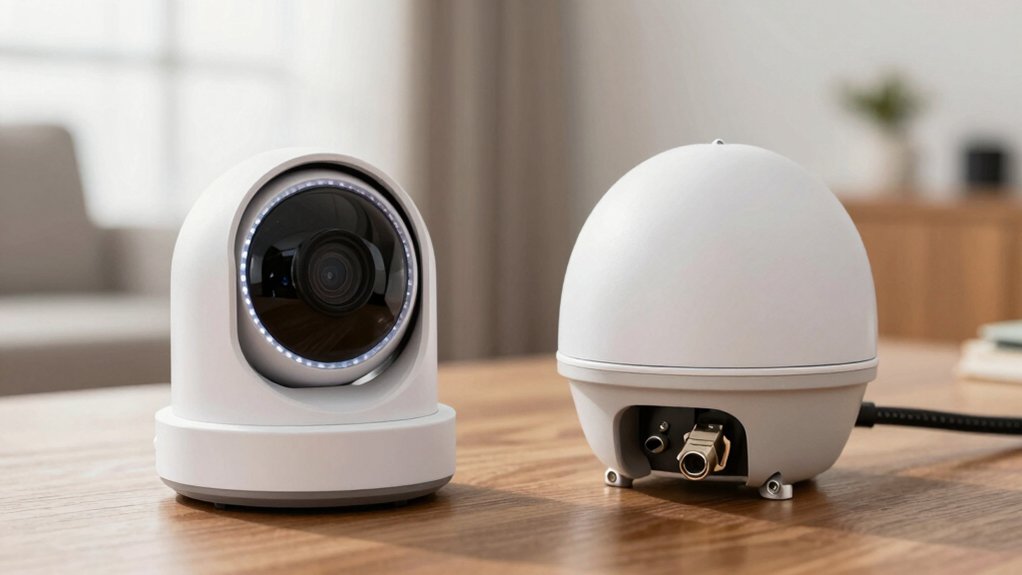
You’ll pick battery cams when you want drill‑free, DIY installs, easy relocation and low upfront cost.
However, they need regular charging, give event‑based recording, and depend on Wi‑Fi range.
Wired (PoE) cams offer continuous power, higher sustained bitrate, local recording, and reliable uptime with UPS support.
Yet, they need cable runs and higher installation expense.
Choose battery for flexible or temporary sites and wired for permanent, high‑availability monitoring. Keep going to see detailed trade‑offs and scenarios.
Battery Security Cameras Vs Wired Security Cameras Pros and Cons: You’ll pick battery cams when you want drill‑free , DIY installs , easy relocation and low upfront cost . However, they need regular charging, give event‑based recording, and depend on Wi‑Fi range. Wired (PoE) cams offer continuous power , higher sustained bitrate, local recording, and reliable uptime with UPS support.
Quick Overview
- Battery cameras allow drill-free, DIY placement and easy relocation; they are ideal for rentals or temporary coverage.
- Wired (PoE) cameras provide continuous power and reliable uptime; they are suitable for 24/7 monitoring and critical sites.
- Battery systems rely on finite runtime and regular battery/maintenance checks, which increases downtime risk during outages.
- Wired installations have higher upfront cabling and labor costs; however, they have lower long-term energy and storage expenses.
- Hybrid setups combine wired for critical views and battery units for flexible or hard-to-wire locations.
3 Questions to Choose Wired Vs Battery (Wireless) Security Cameras?
Which factors matter most when you pick wired versus battery (wireless) security cameras? You should evaluate installation constraints, monitoring continuity, and maintenance cadence. Ask whether you need drill-free, flexible placement: battery cameras win here, ideal for renters or temporary setups.
Compare expected battery life against your tolerance for periodic recharging or replacement; shorter battery life raises maintenance frequency and potential downtime. Check wireless range relative to your site: if signals must traverse walls or long distances, performance can degrade and cause gaps.
For continuous, mission-critical surveillance, you’ll favor wired systems, which deliver uninterrupted data and generally higher sustained video quality. Contrast upfront costs: wired installs usually cost more initially due to cabling and labor but tend to lower long-term energy and upkeep expenses.
Finally, weigh scale: large sites with minimal tolerance for interruptions should lean wired. Small, flexible deployments where easy relocation matters can lean battery-powered.
Power & Reliability: Constant Power, Outages, and Backups for Wired vs Battery Cameras
How resilient do your cameras need to be during power interruptions? Wired cameras provide continuous power via mains or PoE, so you get uninterrupted operation and consistent video quality without battery checks. You can add UPS or generator backups to a wired system to extend uptime; that architecture yields predictable backup reliability and continuous recording during short to moderate outages.
Battery cameras operate from internal cells that will eventually need recharging or replacement, so their runtime during an outage is finite and variable. As battery voltage drops, you may see degraded performance, reduced frame rates, or unexpected shutdowns that compromise footage integrity. Unless you supply external power or swap batteries, battery-only systems are constrained by remaining charge.
In practice, choose wired if you require deterministic continuous power and high backup reliability. Choose battery if flexibility and placement trump strict uptime, but plan for battery management or auxiliary power to mitigate outage exposure.
Installation & Placement: DIY Ease, Wiring Needs, and Relocation for Wired vs Battery Cameras
Thinking about where and how you’ll mount cameras? You’ll weigh installation flexibility vs wiring permanence. Wired systems need power and data runs (often PoE) to a hub; this enforces fixed placement and usually requires a pro installation. Battery cameras give battery independence so you can DIY and test angles quickly.
- Wired: You get stable power/data and minimal maintenance, but wiring permanence reduces relocation feasibility and raises installation time/cost. Conduit, patching, or network ports matter.
- Battery: You gain maximum installation flexibility and easy DIY mounting. Relocation feasibility is high since there’s no rewiring; however, expect periodic battery checks and replacements.
- Hybrid: Use wired for critical, fixed views and battery units for temporary coverage or where wiring is impractical. This balances uninterrupted power with rapid redeployment.
Choose based on site permanence, acceptable maintenance cadence, and whether you prioritize continuous feed over simple redeployment.
Video, Storage & Connectivity: Resolution, Recording Options, and Wi‑Fi Trade‑Offs
Once you’ve settled on camera placement and power method, you need to contemplate how that choice affects video quality, recording options, and network behavior. Wired cameras typically sustain higher video resolution and consistent frame rates because constant power and direct NVR/DVR links avoid Wi-Fi compression and packet loss. That yields cleaner detail for analytics and forensic review.
Battery wireless cameras trade uninterrupted capture for installation flexibility. Their recording options often favor event-based clips to conserve battery and microSD or cloud storage with shorter retention. Expect frequent recharges or battery swaps if you try continuous recording.
Wi-Fi trade-offs matter: congested networks force lower bitrate, reduced frame rate, and heavier compression. This degrades live view and stored footage. Cloud plans add recurring costs and potential upload limits. Local wired storage gives longer retention without subscription.
Choose wired when you need maximum, sustained video resolution and continuous local recording. Pick battery wireless when flexibility matters and you accept constrained recording options and occasional quality variance.
Cost & Use Cases: Upfront vs Ongoing Costs, Maintenance, and Best Choices By Scenario
Wondering which pays off long term? You’ll weigh upfront costs against ongoing costs and maintenance cadence to pick the right system. Battery cameras lower your upfront costs and simplify installation; however, expect recurring expenses for battery replacement (every 4–6 months for non-solar models) and cloud subscriptions. Wired PoE systems demand higher upfront costs and installation effort; however, they reduce ongoing costs via local NVR storage and lower maintenance cadence.
- Compare total cost of ownership: wired PoE often wins for permanent, high-uptime sites due to lower recurring fees despite complex install. Battery systems can be cheaper short-term.
- Maintenance cadence and logistics: battery units require frequent checks and battery swaps. Wired cameras need occasional cable inspections and firmware updates.
- Best use scenarios: choose battery for temporary, rental, or hard-to-reach locations. Choose wired for large facilities, continuous monitoring, and long-term deployments where minimizing ongoing costs is critical.
Frequently Asked Questions
Do Battery Cameras Work in Freezing Temperatures?
Yes, battery cameras can work in freezing temperatures, but battery performance drops as chemistry slows and capacity falls. You will compare cold-rated models versus standard cells; look for low-temperature lithium options and built-in heaters.
Solar charging becomes unreliable with snow and low sun, so do not count on it alone. You will want insulated enclosures, firmware optimized for cold, and a maintenance plan to swap or warm batteries to maintain uptime.
Can I Integrate Battery Cameras With Existing Alarm Systems?
Yes, you can integrate many battery cameras with existing alarm systems, but integration compatibility varies by brand and protocol (Z-Wave, Zigbee, Wi‑Fi). You’ll compare native integrations, third-party hubs, or IFTTT for bridging.
Expect tradeoffs: battery lifespan may shorten with frequent signal or recording activity, or mesh networking duties. Check API support, encryption, and power-management settings to ensure reliable technical interoperability and predictable maintenance intervals.
How Long Does Warranty and Support Typically Last?
Warranty duration typically runs one to three years for consumer cameras. Professional wired systems often offer three to five years.
Support coverage varies: basic phone/email help and firmware updates commonly span the warranty period. Premium plans add extended support, on-site service, and advanced troubleshooting for extra years.
You’ll compare vendors’ SLA terms, firmware update frequency, and optional extended warranties to match your deployment’s reliability and maintenance requirements.
Are There Privacy or Legal Differences Between Types?
Yes, you’ll see privacy differences and legal considerations. Battery and wired cameras both capture footage. However, battery models often use cloud services and wireless transmission, raising data-in-transit and storage jurisdiction concerns. Wired systems can use local recording, reducing external access risk.
Legally, you’ll need to follow consent, recording, and expectation-of-privacy laws. Wireless encryption, data retention policies, and vendor location affect compliance; so design with technical safeguards.
Do Battery Cameras Support Continuous 24/7 Recording With Solar Panels?
Yes, some battery cameras can do continuous recording with solar panels, but it’s conditional. You’ll need a model designed for continuous recording, a solar charging system sized to match power draw, and local or cloud storage that handles constant streams.
Compared to wired units, solar and battery setups demand careful power budgeting, higher-capacity batteries, efficient codecs, and weatherproof panels. If any component underperforms, continuous recording will drop to event-based or scheduled modes.
Conclusion
Choose wired if you need uninterruptible power, higher sustained bandwidth, and centralized recording. It’s best for long-term installs like business premises or fixed home perimeters.
Pick battery (wireless) if you want fast DIY setup, flexible placement, and zero trenching. This option is ideal for renters, garages, or remote spots.
Consider hybrid approaches: wired main units with battery backups or solar-assisted wireless. Match power, installation, and storage needs to your site to optimize uptime and data integrity.
Related reading: Poe Security Cameras and Poe Switches Explained — a closer look at this topic.