Video Doorbell Transformer Requirements Explained
You’ll need a stable low-voltage AC supply, typically 16–24V AC, sized in VA to cover the doorbell, chime and wire losses. Many 1080p/2K units work on 16V–30VA; however, some 4K models prefer 24V and higher VA.
Check the transformer label for voltage and VA. Measure actual output under load with a multimeter. Upgrade to a 16V–30VA or 24V–40VA unit if specs or under-load readings fall short. More practical guidance follows.
Video Doorbell Transformer Requirements Explained: You’ll need a stable low-voltage AC supply , typically 16–24V AC , sized in VA to cover the doorbell, chime and wire losses. Many 1080p/2K units work on 16V–30VA; however, some 4K models prefer 24V and higher VA. Check the transformer label for voltage and VA.
Quick Overview
- Wired video doorbells need a constant low-voltage AC supply, commonly 16V AC for many 2K/1080p models.
- Confirm transformer voltage falls within 16V–24V AC; values outside this range require upgrading.
- Choose a transformer VA rating (e.g., 16V–30VA or 24V–40VA) high enough for doorbell, chime, and wire losses.
- Use multi-tap or correctly tapped single-transformer (8/16/24V) and select the tap that matches your device.
- Verify compatibility by reading the label and measuring under load with a multimeter. Hire an electrician for upgrades.
Which Transformer Voltage and VA Rating Do Wired Video Doorbells Need?
Wondering which transformer you need? You’ll match doorbell compatibility to transformer VA and voltage specs. Wired video doorbells need a constant low-voltage AC supply, commonly 16V AC, with VA sized for the doorbell’s load plus chime and wire losses. For 2K or 1080p models, specify 16V–24V AC; values outside that range mean you should upgrade.
Typical transformer outputs include multi-tap 8V/16V/24V (DH910) and single-tap 16V (T1610). Pick the tap that meets the device requirement. Use examples like 16V-30VA or 24V-40VA as reference ranges; ensure the transformer VA covers peak draw and chime impedance.
Always verify the doorbell model (B862AJ for 4K, B451AJ for 2K, LNWDB1 for 1080p) and choose a transformer with compatible voltage and sufficient transformer VA for reliable operation.
Quick Visual Check: Read the Transformer Label (16–24V AC, VA Rating)
Start by reading the transformer’s label to confirm it outputs 16–24V AC and shows a VA rating sufficient for your doorbell and chime. For a quick visual check, locate the output voltage line and the VA (volt-ampere) number. If the label lists 16–24V AC and a VA rating that matches or exceeds your doorbell specification, the transformer is likely compatible.
A 10VA label commonly supports a single standard chime; 20VA supports dual-chime or higher-draw video units. If the label shows voltages outside 16–24V AC, the transformer isn’t suitable and should be replaced. Use the VA rating to determine capacity: doorbells requiring continuous draw or powering additional chimes need higher VA.
The transformer label is your immediate, reliable source for compatibility decisions without testing equipment. Record the labeled voltage and VA before installation and consult the doorbell’s spec sheet to confirm that the labeled capacity meets its steady-state and inrush requirements.
Measure Transformer Voltage With a Multimeter : What Readings Mean
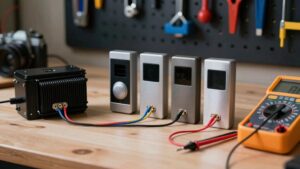
After confirming the transformer’s label, verify actual output with a multimeter by measuring across the two transformer terminals while the power is on and you follow proper safety precautions. Place the meter probes directly on the two transformer wires or terminal screws; this ensures accurate measuring voltage for transformer compatibility assessment.
A stable reading between 16V and 24V AC indicates the transformer is compatible with most 2K and 1080p Lorex wired doorbells. Values at or near 16V–24V AC mean you can proceed with installation; however, confirm VA rating (16V–30VA or 24V–40VA) matches chime and doorbell model requirements. If the meter reads about 10V AC or any value outside 16V–24V AC, the transformer is unsuitable and should be upgraded.
Document the measured voltage under load if possible; unloaded voltages can be slightly higher. Use these measurements to decide replacement or compatibility rather than label alone.
Where to Find the Transformer in Your Home (Basement, Panel, Furnace, Attic)
Where is the transformer located in your home? You’ll commonly find it near the main electrical panel, in basements, garages, attics, or inside the furnace room. Look for a small metal box mounted on a wall or inside a junction box with two terminals.
Labels showing voltage (16V or 24V) and VA rating help confirm identity. It’s often hidden behind panels or tucked in closets; check adjacent to the furnace or water heater where chime wiring and electrical chases run. Do not treat transformer finding as an unrelated topic to wiring. Efficient inspection saves time and aids time management.
| Location | What to look for |
|---|---|
| Main panel area | Small metal box, labeled voltage |
| Basement | Wall-mounted near chases |
| Furnace room | Behind panels, near controls |
| Attic | Along HVAC runs |
| Garage/closet | Junction boxes, terminal screws |
Inspect visually before testing. If you can’t find it, trace the doorbell wiring to its nearest chase or junction.
When and How to Upgrade Your Doorbell Transformer (Models, VA Sizing, Electrician Tips)
Now that you know how to locate the transformer in your home, check its voltage and VA rating to see if it matches your video doorbell’s requirements. Many modern 4K or dual-chime models call for roughly 24VAC and 30VA or more. Measure the output with a multimeter: if it reads below 16VAC or above 24VAC, or the VA is below the doorbell’s spec, plan an upgrade.
Typical replacements are 16V–30VA or 24V–40VA units. For 4K or multi-chime systems, use ~24VAC, 30VA+. Choose a transformer rated for expected wire length and simultaneous chime loads. This isn’t an irrelevant topic nor an unrelated concept to installation success; insufficient VA causes brownouts, intermittent recording, or no chime.
Always hire a licensed electrician to disconnect mains, mount the transformer, verify voltage under load, and follow the doorbell manufacturer’s wiring diagram. Document final readings and confirm the system functions before closing the panel.
Frequently Asked Questions
Can a Doorbell Transformer Work on a Dimmer Circuit?
No, you shouldn’t put a doorbell transformer on a dimmer circuit. Dimmer controls vary voltage and waveform, causing heating, noise, or incorrect voltage that can damage the transformer or connected chime or doorbell.
For reliable doorbell wiring and transformer compatibility, feed the transformer from a dedicated, unswitched 120V circuit or a properly rated junction. Use correct gauge wiring, follow manufacturer specs, and consult an electrician for code-compliant installation.
Will a Transformer Affect My Wi‑Fi Signal Strength?
Generally, no; a transformer itself won’t noticeably weaken your WiFi signal. You might see issues if a faulty or poorly shielded transformer generates electrical noise that causes WiFi interference on nearby electronics or shared wiring.
Keep transformers grounded, use quality shielded units, separate low-voltage and data cables, and avoid placing transformers next to routers. Those steps minimize electromagnetic noise and reduce the chance of electrical-noise driven WiFi interference.
Can I Use a Battery Backup With a Wired Transformer?
Yes, you can use a battery backup with a wired transformer. You’ll wire the transformer to supply continuous AC to the doorbell while the battery backup provides temporary power during outages via an inline inverter or purpose-built UPS rated for the transformer’s VA and voltage.
Ensure the backup’s output matches the transformer input (typically 16–24 VAC). Additionally, verify that surge protection, proper grounding, and current capacity are in place to prevent overheating or device damage.
Do Outdoor Temperatures Impact Transformer Performance?
Yes, outdoor temps affect transformer performance. You’ll see changes in resistance and core losses as temperatures drop or rise, which alters output voltage and efficiency. Cold increases winding resistance and can reduce inrush capacity. Heat raises no-load current and accelerates insulation aging.
Specify temperature-rated transformers, allow ventilation, and use thermal protection or compensation if you operate near extremes to maintain stable transformer performance.
Are Smart Chimes Compatible With Standard Transformers?
Yes, many smart chimes work with standard doorbell transformers. However, transformer compatibility depends on voltage, VA rating, and whether the chime needs constant power.
You’ll check the transformer’s output (typically 16–24 VAC) and its VA capacity against the smart chime’s requirements. If the transformer lacks sufficient VA or steady current, you’ll need a higher-capacity or compatible transformer; alternatively, you may require an inline power adapter to ensure reliable smart chime operation.
Conclusion
Check your transformer label first. Most wired video doorbells need 16–24 VAC and typically 10–30 VA depending on model. Verify actual output with a multimeter; no-load vs. under-load readings matter. Locate the transformer near the panel, furnace, or in the attic/basement.
If voltage is out of range or VA is insufficient for continuous video streaming, replace it with a properly rated 16–24 VAC transformer sized to the doorbell’s VA requirement. Hire a licensed electrician for upgrades.
Related reading: Video Doorbell Transformer — a closer look at this topic.