Ptz Security Cameras Vs Fixed Security Cameras Explained
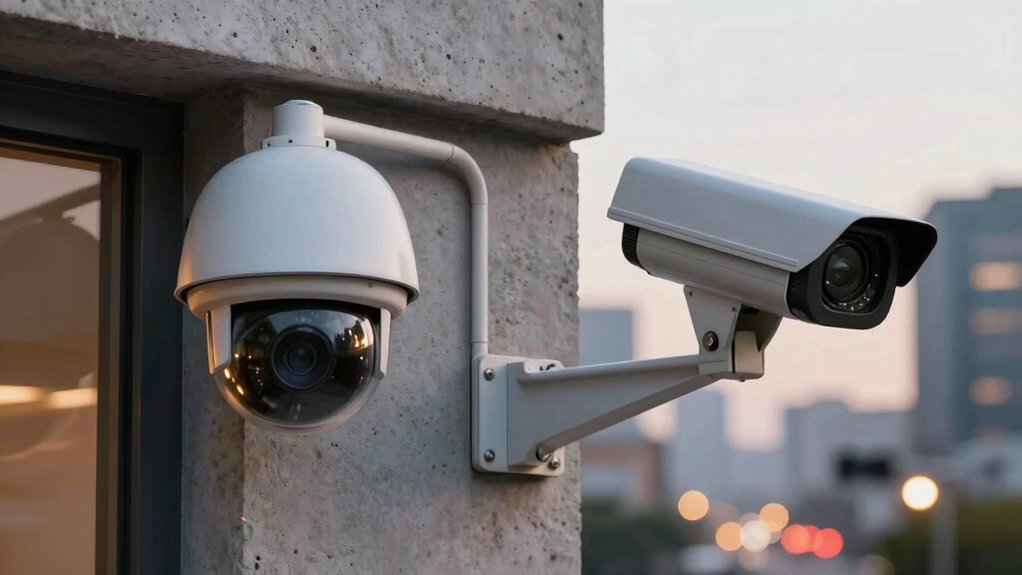
You’ll pick PTZ when you need dynamic pan/tilt/zoom to patrol wide perimeters and follow incidents.
You will choose fixed when you require continuous, high‑detail coverage for entrances, assets, or evidence.
PTZs can replace several fixed units; however, they risk missed detail during movement and need more maintenance.
Fixed cams are lower‑cost, reliable, and bandwidth‑efficient, but they need multiple units for full coverage.
A hybrid design usually balances tracking and forensic needs.
Keep going and you’ll get practical setup and remote‑site checks.
Ptz Security Cameras Vs Fixed Security Cameras Explained: You’ll pick PTZ when you need dynamic pan/tilt/zoom to patrol wide perimeters and follow incidents. You will choose fixed when you require continuous, high‑detail coverage for entrances, assets, or evidence. PTZs can replace several fixed units; however, they risk missed detail during movement and need more maintenance.
Quick Overview
- PTZ cameras pan, tilt, and zoom for dynamic, wide-area coverage; however, they can miss detail while moving.
- Fixed cameras provide constant, high-quality imagery for entrances and evidence-critical zones with lower maintenance.
- One PTZ can replace multiple fixed cameras through presets and patrols. This reduces hardware but increases operational risk.
- Hybrid setups use fixed anchors for continuous proof and PTZs for situational tracking. This balances clarity and flexibility.
- Remote sites favor energy-efficient fixed streams and event-triggered PTZs to manage bandwidth, power, and maintenance.
Quick Recommendation: Which to Pick – PTZ, Fixed, or Hybrid
Which setup makes sense for your site depends on coverage goals and operational constraints. You’ll choose fixed when you need continuous, high-quality imaging of known risk zones: entries, cash points, storage. Fixed units deliver stable frames, lower cost, and reduced maintenance.
Opt for PTZ when you must monitor expansive areas or perimeters. A single PTZ can replace several fixed cameras by panning, tilting, and zooming to follow subjects; however, it risks missing detail while moving and needs more upkeep.
A hybrid strategy is the pragmatic default in most PTZ vs fixed evaluations: deploy fixed cameras for 24/7 vigilance at critical points and add PTZs for flexible tracking and investigative zoom on distant activity. Also factor in insurance and regulatory requirements favoring continuous point coverage plus incident-followup capabilities.
Quantify coverage density, bandwidth, and maintenance capacity before deciding. The optimal mix minimizes blind spots while balancing lifecycle costs and operational complexity.
PTZ vs Fixed: Key Differences at a Glance
Want to quickly see how PTZ and fixed cameras differ in function and trade-offs? In a concise ptz vs fixed comparison, PTZ cameras offer pan, tilt, and zoom to dynamically cover expansive areas and can substitute multiple fixed units. You control PTZs remotely, program presets, and run patrols for flexible response. However, movement can obscure fine detail, and mechanisms increase maintenance needs.
Fixed cameras deliver a static field of view with consistent, high-quality imagery optimized for persistent monitoring of entry points, cash registers, or lanes. Fewer moving parts mean lower cost and higher long-term reliability. A technical trade-off matrix shows PTZs maximize coverage and adaptability at the expense of constant detail and mechanical simplicity. In contrast, fixed cameras maximize continuous fidelity and minimal upkeep but require multiple units for full coverage.
Operationally, many deployments use a hybrid approach: fixed cameras for critical, detail-sensitive zones and PTZs for perimeter patrol and situational flexibility. This approach balances cost, coverage, and maintenance.
When to Choose PTZ Cameras (Coverage, Tracking, Staffing)
After weighing the hybrid benefits of fixed and PTZ systems, consider PTZs when you need expansive, on-demand coverage and active tracking rather than continuous static detail. You’ll deploy PTZs for sprawling perimeters, yards, or remote site setup where one device replaces multiple fixed units and delivers optical zoom for investigative detail.
PTZ limitations still apply: a single head can’t capture all angles simultaneously, so you’ll address blind spots via automated patrols, preset tours, or supplementary fixed nodes.
Assess staffing needs critically. PTZs demand either active operators or reliable analytics to prevent missed events; automation reduces human load but raises fixed costs and integration complexity. Account for maintenance wear from mechanical motion; budget higher service intervals and potential replacements.
Use hybrid strategies when you want dynamic tracking without sacrificing persistent coverage. Combine PTZs for long-range response with selective fixed cameras for constant situational awareness.
When to Choose Fixed Cameras (Constant Clarity, Low Maintenance)
Where do fixed cameras make the most sense? You deploy fixed cameras when you need constant clarity over defined zones: entry points, high-risk areas, and equipment storage where a single, stable field of view captures all required detail. Fixed optics and non-moving hardware reduce motion blur and deliver sharper images, which improves low-light performance and resilience in dusty or windy conditions.
You’ll also benefit from predictable coverage for uninterrupted recording, supporting compliance, insurance documentation, and forensic review without reliance on operator control. Economically, fixed units cost less up front and incur lower maintenance because they lack PTZ motors and complex control systems, reducing failure modes and service intervals. Their limitation is spatial flexibility; you must site multiple units to cover evolving layouts.
Use fixed cameras where image stability, continuous monitoring, regulatory evidence, and low maintenance are primary requirements. Accept that scalable coverage will require additional cameras rather than pan/tilt capability.
Hybrid Strategy: Balancing PTZs and Fixed Cameras for Remote Sites
Fixed cameras anchor your site with stable, high-resolution feeds. However, remote locations often demand the reach and flexibility that PTZs provide. A hybrid approach pairs fixed units at choke points with PTZs for perimeter patrol and dynamic tracking.
You’ll deploy fixed cameras to continuously monitor entrances, storage, and other static hazards where consistent image quality and low maintenance are critical. PTZs then cover expansive yards; they reduce the number of devices by panning, tilting, and zooming to follow activity. However, they consume bandwidth and can miss detail while moving or idle.
Environmental stressors, such as dust, wind, and vibration, degrade PTZ reliability more than fixed heads. Therefore, you’ll site PTZs where access and structural stability support moving parts. SentryPODS-style, solar-capable PTZ nodes demonstrate a modular hybrid strategy for remote sites: fixed nodes anchor evidence capture while flexible PTZs extend situational awareness.
Your system design should quantify coverage overlap, control latency, and bandwidth to balance continuous recording with dynamic patrol functions.
Remote-Site Checklist: Environment, Power, Bandwidth, and Setup
How will environmental stresses, power limits, and bandwidth caps shape your remote-camera choices? Assess the remote site for dust, wind, vibration, and sunlight exposure; these factors degrade PTZ gear faster than fixed housings and should drive installation considerations toward robust mounts and sealed enclosures.
Quantify available power—solar, battery, or intermittent grid—and select energy-efficient fixed cameras where possible. Reserve PTZs with battery backup for intermittent active monitoring. Measure bandwidth and set bitrate targets: prefer low-bitrate fixed streams and enable event-triggered PTZ streaming to avoid congestion.
Design a hybrid setup: continuous fixed-camera coverage for baseline recording plus limited-use PTZs for targeted inspection. Specify power budgets, expected autonomy under worst-case solar conditions, and network QoS rules that prioritize alarm video. Draft cabling and mounting plans that minimize vibration and allow future sensor additions.
Conclude with a maintenance schedule focused on lubricating PTZ mechanics, swapping batteries, and validating remote connectivity to sustain uptime.
Frequently Asked Questions
Do PTZ Cameras Require More Maintenance Than Fixed Cameras?
Yes, you’ll typically need higher maintenance frequency for PTZ units. You’ll monitor moving parts, motors, and gears for component wear and recalibrate pan/tilt mechanisms more often.
You’ll also update firmware, lubricate bearings, and inspect wiring due to increased mechanical complexity. Fixed cameras have fewer failure modes; therefore, they demand less routine servicing.
Plan scheduled checks and predictive replacement intervals to minimize downtime and preserve positional accuracy.
Can PTZS Be Integrated With Video Analytics and AI?
Yes, you can integrate PTZs with video analytics and AI. You’ll deploy integrated analytics on the camera or at the edge, enabling object detection, tracking, and event-driven auto‑pan/zoom.
Ensure AI compatibility by confirming SDKs, supported models, and processing capacity. PTZ telemetry must feed analytics for accurate framing.
Plan bandwidth, latency, and firmware updates to maintain model performance and reliable, low‑latency control loops between analytics and camera motion.
Do PTZ Cameras Deter Vandalism or Theft More Effectively?
Yes, PTZ deterrence often reduces vandalism and theft more effectively because you can actively track suspects, zoom for ID, and cover wide areas with one device. You’ll get dynamic response and visible motion that discourages wrongdoing.
Fixed surveillance offers consistent, tamper-resistant coverage and predictable analytics; it complements PTZs for redundancy. Use both: PTZs for active deterrence and incident capture, fixed units for uninterrupted scene context and evidence.
How Do PTZ and Fixed Cameras Compare for Low-Light Performance?
PTZ and fixed cameras differ. You’ll find fixed cameras often deliver better low light capabilities due to larger sensors and optimized lenses. Meanwhile, PTZs sacrifice sensitivity for zoom mechanics.
You’ll evaluate infrared performance similarly: fixed units usually offer more uniform IR illumination and longer range. In contrast, PTZ IR can be uneven when zoomed.
Choose based on scene: wide, static coverage favors fixed. Flexible tracking needs PTZ despite modest low-light tradeoffs.
Can PTZ Presets Be Automated on Schedules or Events?
Yes, you can automate PTZ presets on schedules or in response to events. You’ll configure PTZ automation within the camera or VMS. Assign Event presets triggered by motion, alarms, or analytics.
Schedule-based PTZ automation runs timed tours or preset sequences. Ensure preset positions, dwell times, and transition speeds are defined. Test priority rules so event presets override schedules when needed for critical incidents; this maintains predictable, auditable behavior.
Conclusion
Choose PTZ, fixed, or a hybrid based on coverage needs, operational resources, and network constraints. Use PTZs where dynamic tracking and wide-area surveillance reduce camera count; however, expect higher bandwidth, latency sensitivity, and maintenance.
Use fixed cameras where constant high-resolution detail, lower power, and simpler management matter. For remote sites, combine PTZs for patrols with fixed units for continuous clarity. Validate environment, power, and bandwidth before deployment to ensure reliable performance.
Related reading: PTZ WiFi Security Cameras — a closer look at this topic.